

Taylor Swift often receives a lot of criticism in the media. She dates too many guys or she’s not as good as Beyoncé – but by far Swift critics tend to chide her the most for her delayed responses to feminist issues, including sexual assault.
Now, Swift has spoken out about her own sexual assault. In 2013, radio DJ David Mueller allegedly lifted Swift’s dress and groped her during a photo op. Swift reported Mueller’s behavior to Mueller’s boss. In response, the radio station terminated Mueller. Two years later, Mueller sued Swift for $3 million, claiming her allegation cost him his $150,000 job at the radio station.
Faced with a lawsuit for reporting Mueller, Swift counter-sued Mueller for assault and battery. The catch – Swift claimed only $1.00 in damages.
On August 15, 2017, a jury found Mueller liable for Swift’s sexual assault and awarded her $1.00. Many celebrities from Amber Heard to Hillary Clinton and other took to social media to offer their support.
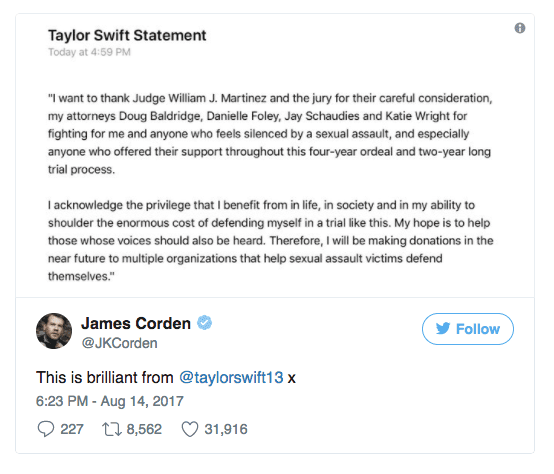
Critics of Swift have again called her out for her delayed response – if she really thought Mueller’s conduct was so bad, why didn’t she sue him first? Why did she only sue for $1.00 in damages?
In reality, Swift had a fairly common response to Mueller’s conduct. Women often feel pressure not to “make a big deal” out of sexual assault. As a result, many women want to forget or adopt a “just-don’t-do-it-again” mentality towards their aggressor.
That’s likely how Swift felt – until Mueller’s ego prevented Swift from private justice.
Swift also presumably meant for her counter suit against Mueller to be symbolic. Swift wanted to show that victims of sexual assault do not sue their perpetrators to become rich – they do it for justice.
Unfortunately, the small price tag Swift placed on her own assault may have failed to actually teach Mueller, and men like him, a lesson. In response to the jury’s verdict, Mueller said he would pay Swift with a Sacagawea dollar and stated: “I mean if this is all about women’s rights … it’s a little poke at them, a little bit. I mean, I think they made this into a publicity stunt, and this is my life.” Clearly, Mueller still doesn’t get it.
So, what does Swift’s lawsuit mean?
Ultimately, it means that regardless of whether someone inappropriately touches you in an obscene way for a split second or for many seconds – you have a right to justice. You have a right to private justice – like reporting the behavior to a supervisor – or public justice – like in a court of law – or both.
Swift’s lawsuit also highlights the importance of a proper valuation of your damages. Your emotional, psychological, and physical well-being is worth significantly more than $1.00. Although Swift meant well with her symbolic lawsuit, a $1.00 judgment does not adequately hold a perpetrator responsible for his conduct or prevent the behavior from recurrence.
If you have experienced sexual assault, take action on behalf of yourself or to stop it from happening to someone else.
Lawyers who specialize in sexual assault answer questions anonymously, and free of charge in a consultation. If you have a question, feel free to call us at (619) 516-8166
Read more:
Sexual Assault Lawyer in San Diego
Related Posts

When Jessica Pride introduced in-house survivor advocacy at The Pride Law Firm, she wanted clients to have support beyond legal advice. Today, advocates work alongside attorneys to help survivors navigate the emotional and practical challenges of pursuing a civil lawsuit.

Trauma-informed legal representation goes beyond understanding how trauma affects survivors. Learn how Jessica Pride and The Pride Law Firm help survivors feel informed, supported, and involved throughout the legal process.

Why do some memories of sexual assault remain vivid while others are difficult to recall? Jessica Pride explains how trauma can affect memory, why gaps or inconsistencies don't undermine credibility, and what to know when considering legal action.

Can you file a sexual assault lawsuit without making your identity public? California courts may allow survivors to proceed as Jane Doe. An attorney can help you understand the process, what privacy protections may be available, and what happens if those protections are violated.

The public response to sexual assault allegations at Cornell University has raised difficult questions about survivor privacy. Jessica Pride reflects on why survivors deserve control over their identities and when and how their stories are told.

After a sexual assault at work, how do you decide what to do next. Knowing what to consider now and the legal options available can help you make informed decisions about your safety and your job.

A sexual assault at an Airbnb can raise questions about responsibility beyond the person who committed the assault. Hosts, property owners, Airbnb, and other parties could also face a civil claim.

When child sexual abuse happens at school, the school may also bear responsibility. Understanding negligence, mandated reporting, and school liability can help survivors and families explore their legal options.
